Price and quantity
How much do domed stickers cost? Price factors explained
Area, quantity, the minimum order value and design preparation: a clear explanation of the calculation and when more labels can cost the same.
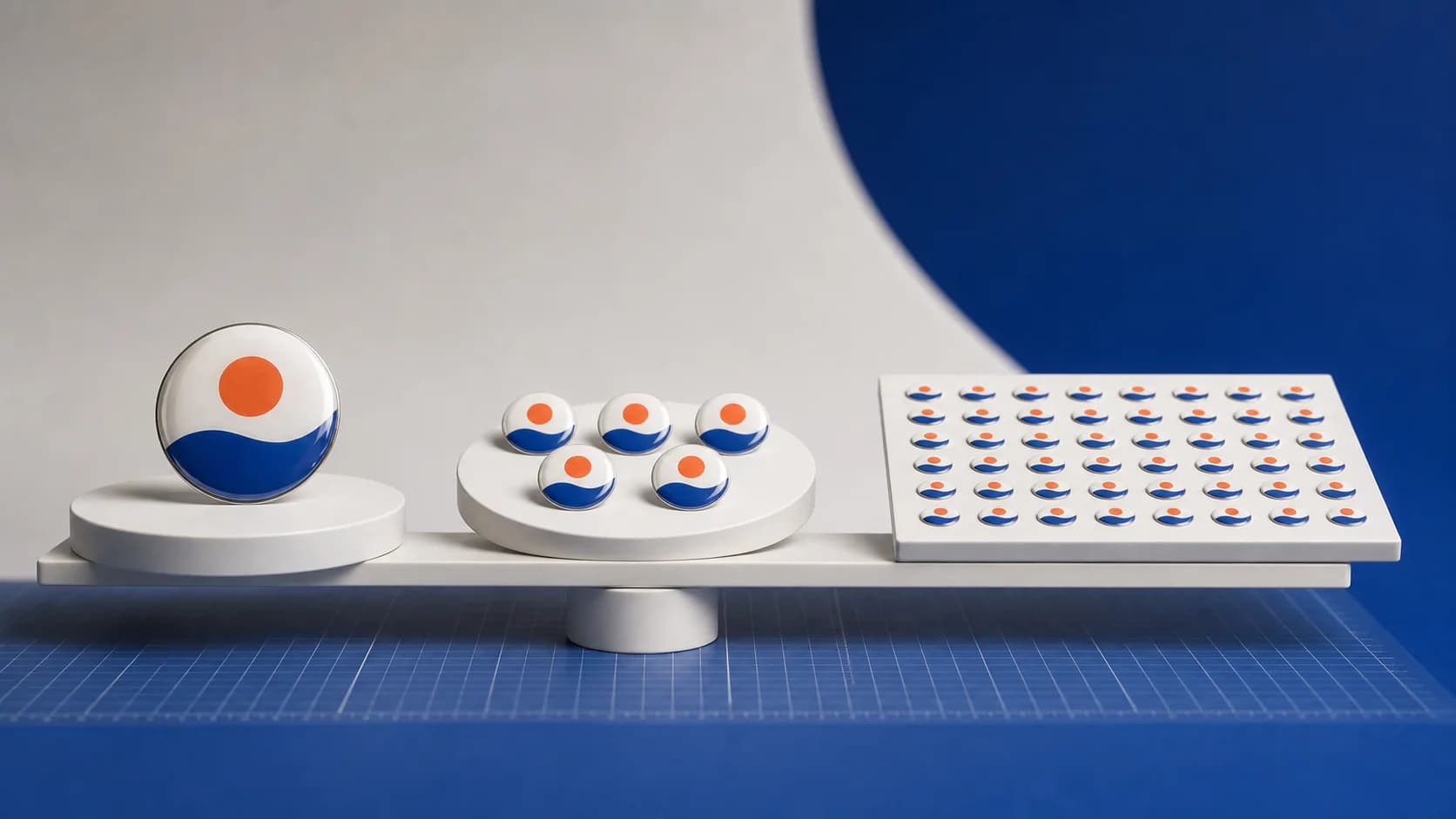
The price of domed stickers depends on more than the number of pieces. Two batches of 100 can differ substantially when one uses a 20 mm circle and the other an 80 × 40 mm rectangle. The main measurable factor is total batch area: the geometric area of one item multiplied by its quantity.
The online order recalculates as soon as shape, dimensions and quantity are selected. Pricing settings can change, so the current calculator is more reliable than a figure preserved in an old article or advertisement. Once an order is created, its price snapshot remains attached to that order.
Compare the final cost of the useful size and quantity—not an isolated per-piece figure with no context.
The right comparison method
The basic calculation
The system first calculates the real geometric area. A circle uses the area of a circle, an oval the area of an ellipse, and squares and rectangles the product of their sides. Decorative corner rounding is not subtracted in the simplified rectangle model. Area is multiplied by quantity and the current rate per unit of area.
A minimum product value is then applied because every order requires preparation, production setup and handling, even for a tiny batch. A fixed order component is added afterwards to cover shared order-level costs. If design preparation is selected, it appears as a separate line and is added to the total.
When a larger quantity can cost the same
Suppose the calculated production value for 50 labels remains below the minimum. As long as increasing the quantity does not push the calculated area above that threshold, the total remains unchanged. The interface can therefore suggest the largest useful quantity within the same amount. This is not free production—the minimum production cost has already been reached.
The suggestion is helpful for replacement stock, repeat customer contact or several locations. Extra pieces are not always wise, however. If the logo, address, QR destination or product designation will change soon, a smaller current batch is more valuable than a large obsolete one.
The strongest price drivers
- diameter or width and height of each item;
- shape geometry and its real area;
- total number of identical labels;
- the current area rate and minimum product value;
- the fixed order component;
- optional professional artwork preparation.
Comparing two configurations
- Define the real need
Identify the smallest legible size and the number of objects that actually require labels.
- Calculate the baseline
Enter the shape, dimensions and quantity and record the displayed total.
- Try a neighbouring size
A few millimetres may be visually insignificant while changing the total area noticeably.
- Review the quantity suggestion
When the minimum applies, the calculator shows how many more pieces fit within the same total.
- Add design only when needed
Artwork preparation should remain a visible separate service, not disappear inside the product cost.
What not to sacrifice for a lower price
Do not shrink a logo until it becomes unreadable or choose a complicated contour solely because its area appears lower. An unsuitable size makes the entire batch a waste. Saving is sensible only when a 1:1 proof confirms legibility, the surface is appropriate and the quantity reflects an actual need.
The most accurate answer to ‘how much do domed stickers cost?’ comes from configuring the specific order. Select a shape, enter millimetres and quantity, and the calculator will show the current total, list design preparation separately and suggest a useful quantity within the minimum order value.
How it looks

