Business ideas
Domed logo stickers: 12 practical ideas for business
Where a small resin dome label genuinely improves a product—from packaging and equipment to QR codes and corporate gifts.
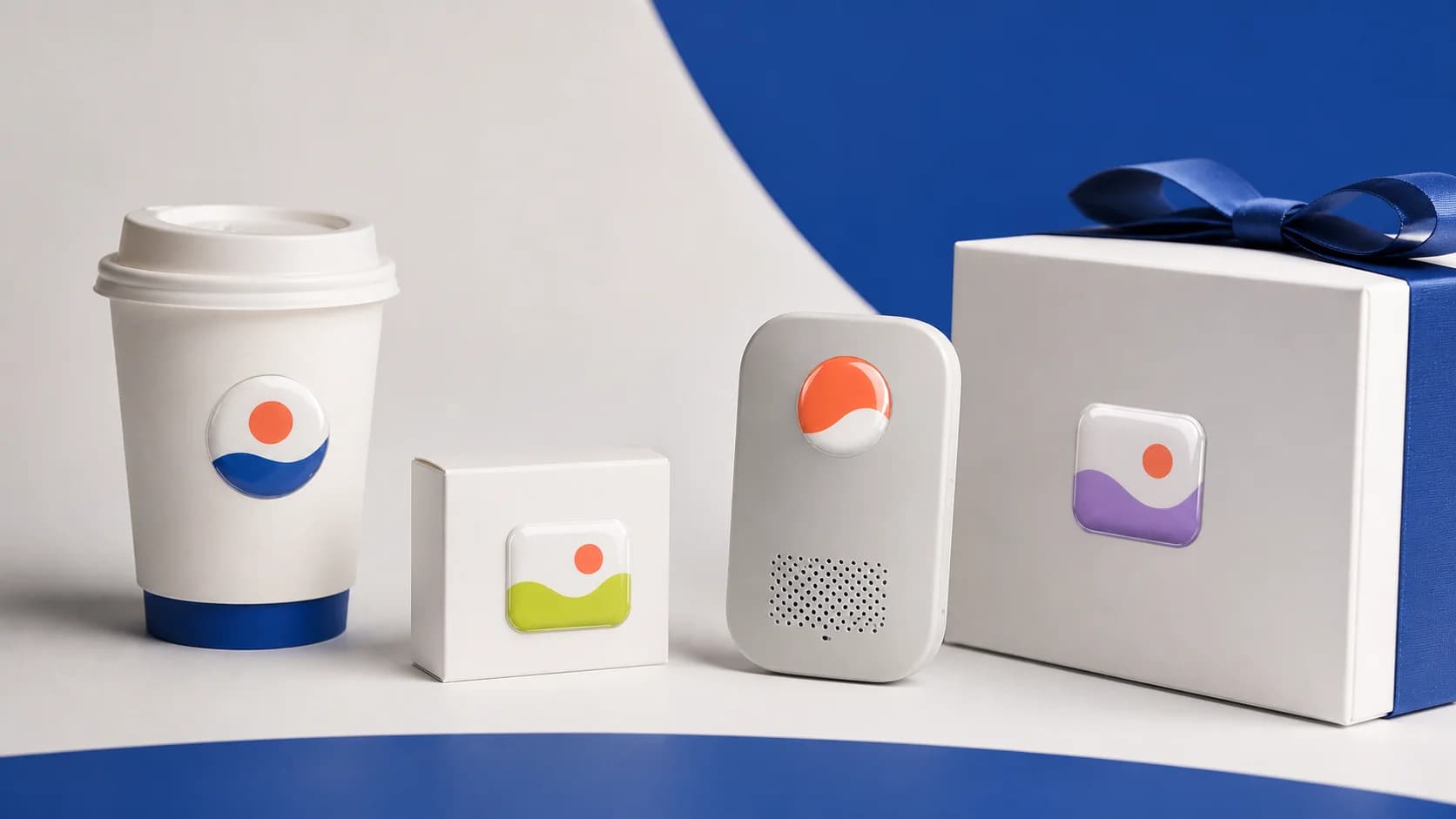
A domed logo sticker adds a branded mark to an existing object without redesigning its casing, mould or packaging. A full-colour image is printed on an adhesive base and covered with a clear polymer lens. The gloss, depth and rounded edge make a small mark feel like a deliberate product detail rather than an improvised paper label.
This approach is especially useful for small and medium-sized businesses. Instead of commissioning custom-moulded parts or a factory run of fully printed merchandise, a company can produce one batch of dome labels and use it across several compatible objects. The surface, dimensions and real-world scale still need to be checked before production.
A good dome label does not compete with the object. It makes the object feel finished and recognisable.
A restrained branding principle
12 ways to use domed logo stickers
- Casings for electronics, instruments, accessories and compact equipment.
- Reusable coffee cups, flasks, containers and tabletop signs.
- Limited-edition packaging, gift sets and pilot product launches.
- QR codes for menus, instructions, warranties, reordering or product pages.
- Equipment identification in an office, shop, salon, café or workshop.
- Corporate gifts such as power banks, cases, notebooks and staff kits.
- Service labels with a model reference, support route or short contact detail.
- Branding neutral stock items without printing every product type separately.
- Small information plates on displays, samples and demonstration units.
- Serial identifiers where the artwork and order workflow support variable data.
- Event, partner and team merchandise.
- Accent labels on transport or coffee containers after testing the actual surface.
When a dome is more useful than a flat label
A polymer lens is most effective when a mark should feel integrated with an object and remain in view. It can give a smooth device, reusable box or gift a finished appearance. A conventional flat label is often more sensible for disposable shipping packaging, ingredient information, expendable barcodes or long blocks of text.
Choosing a logo size
Start with the object, not the file. Measure the clear flat area in millimetres, leave visual breathing room and print a 1:1 paper outline. On a compact item, a mark usually feels confident when it occupies a visible but not maximal portion of the available space. A logo with hairlines and a tiny descriptor may need a larger label or a simplified responsive version.
Shape changes perception too. A circle contains a compact symbol, an oval supports a horizontal name, a rounded square works for an icon and short descriptor, and a rectangle suits a longer composition. A custom contour can reinforce recognition, but needle-like projections and sharp corners make an even resin dome less predictable.
One batch across several objects
The economics improve when a single size suits multiple products. The same rounded-square label might work on a box, case and device. This only helps when every surface and scale remains suitable. A label chosen for the smallest object may disappear visually on large packaging, so universality should not come at the expense of legibility.
Plan the application system before the quantity. The label then becomes part of the brand rather than spare stock looking for a purpose.
A practical planning rule
What to prepare before ordering
- a list of objects and photographs of their flat application areas;
- accurate available dimensions in millimetres;
- a vector logo or the best available raster original;
- a simplified priority version without unnecessary small detail;
- a useful quantity with a modest reserve for future products;
- the operating environment: indoors, outdoors, frequent handling or wet cleaning.
The online order lets you choose the shape, dimensions and quantity before uploading your own artwork or requesting design preparation. The preview is useful for composition, but a 1:1 paper test on the real object remains the best check of physical scale.
How it looks

